
Executive Summary
A commercial financial simulation prepared for a European poultry operation demonstrates that investment in a KNLL-6000 SHW composting system can transform poultry manure from a waste management expense into a profitable organic fertilizer manufacturing business. Unlike a simple payback calculation, this model represents an actual commercial operating scenario based on production capacity, operating costs, fertilizer sales, and projected financial performance. Although it is based on European costs and market assumptions, it provides the first commercial evidence that fertilizer production using a KNLL-6000 SHW system can become a profitable business model. While the financial results cannot be directly applied to the United States, they provide a valuable commercial reference supporting the economic feasibility of developing similar projects under U.S. operating conditions.
Project Overview
- Processing capacity: approximately 2,000 metric tons of poultry manure per month
- Products: solid organic fertilizer and liquid fertilizer (using an air scrubber).
- Annual production: approximately 5,760 metric tons of solid fertilizer and 1,800 m3 of liquid fertilizer.
Financial Results
| Indicator | Value |
|---|---|
| Annual Revenue | €900,000 |
| Annual Operating Expenses | €398,629 |
| Profit Before Tax | €596,870 |
| Annual Net Profit | €501,371 |
| Estimated Net Profit Margin | ~56% |
Business Significance
The simulation demonstrates that manure can be converted into value-added fertilizer products capable of generating substantial annual profits. Instead of viewing manure solely as a waste management challenge, the project illustrates how it can become a revenue-generating business based on fertilizer manufacturing.
Application to the U.S. Market
This simulation should be viewed as a commercial feasibility example rather than proof of realized profitability under U.S. conditions. A U.S. financial model should incorporate local construction costs, labor, utilities, financing, taxes, transportation, fertilizer pricing, and market demand. Nevertheless, the European example provides strong support that, under commercial operating conditions, a KNLL-6000 SHW system can become the foundation of a profitable organic fertilizer business.
Strategic Observation
Long-term success in the United States will depend not only on the profitability of fertilizer production, but also on producing a premium-quality OMRI Listed organic fertilizer that meets the expectations of the U.S. market. While OMRI Listing confirms that a fertilizer is approved for use in certified organic production, successful companies such as Replenish Nutrients, Pro-Gro, Suståne Natural Fertilizer, Nature Safe, Perfect Blend, and The Andersons differentiate their products through independent laboratory analyses, consistent nutrient quality, documented agronomic performance, and proven benefits to soil health and crop productivity. This represents the benchmark that fertilizer produced using KNLL technology should strive to achieve in the U.S. market.
15-Year Liquidity Growth
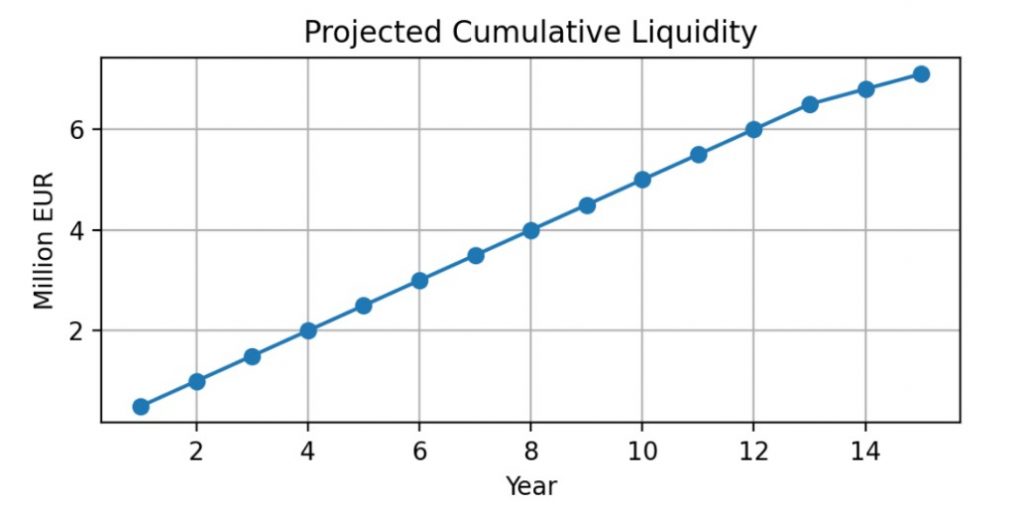
The European commercial simulation projects steady growth in cumulative liquidity over the 15-year planning horizon. Assuming relatively stable production, sales, and operating costs, cumulative liquidity increases from approximately €0.5 million after the first year to more than €7 million by Year 15. The trend indicates that, once the initial investment has been recovered, the project continues generating positive cash flow each year, supporting long-term financial sustainability.
Investment Perspective
Although the simulation does not explicitly calculate annual ROI or IRR over the 15-year period, the continuous growth in cumulative liquidity suggests a stable return on investment after the initial payback period. For a U.S. feasibility study, the same analysis should be repeated using U.S. construction costs, operating expenses, fertilizer prices, financing terms, and taxes.